Knecht’s poem “Stages”
The Glass Bead GameKnecht’s poem “Stages” is a youthful poem whose changing title records a lasting spiritual admonition: to move through each stage of life without mistaking any one of them for a final home. Rediscovered in its original manuscript during a farewell visit to Fritz Tegularius, it allows Knecht to recognize that a verse he had nearly forgotten still carries the inward summons that shaped his life.
Manuscript and rediscovery
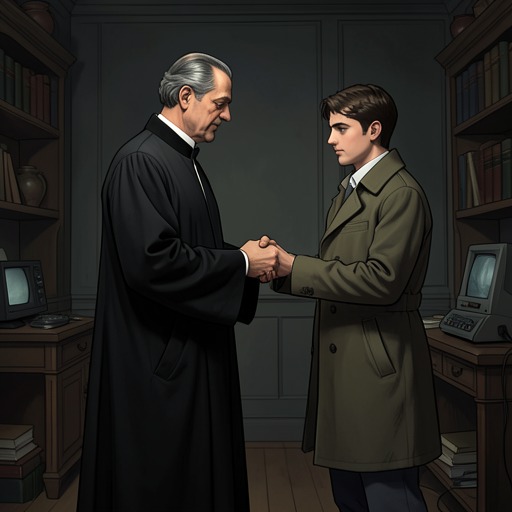
The poem returns to the narrative not through a formal recitation or public literary occasion, but in a private conversation between old friends. Knecht mentions that a few lines from an old poem have come to mind and asks whether Tegularius knows where the rest can be found. Tegularius traces the lines, then retrieves from his desk drawer the manuscript of Knecht’s poems, which Knecht had given him long before. Among its pages he finds two sheets containing the poem’s first draft and hands them back to their author.
The physical manuscript makes the encounter more than a recovery of words. Knecht studies the sheets: their faintly yellowed paper, his youthful handwriting, and the deletions and corrections bring back the distant period in which they were written. He remembers the mood of that earlier self, and connects the poem to a day of spiritual shock he had called an awakening. The poem’s meaning thus returns through both language and material traces: its text has endured, while the paper records the young writer’s revisions and the distance between that moment and the man reading it again.
From “Transcend!” to “Stages”
The draft preserves a revealing alteration. Before the poem itself was written, Knecht had placed “Transcend!” above it in large, impetuous script, apparently intending the word as the opening line. Later, in another mood and situation, he crossed out both that title and its exclamation mark, replacing them in smaller, thinner, more modest writing with “Stages.” The surviving page holds the two conceptions together: a forceful imperative and a title that names a passage through successive phases.
Knecht recalls that “Transcend!” was not an abstract slogan. It had been an invocation and a resolve addressed to himself: to place his actions and his life under the sign of transcendence, moving onward with serenity, filling each place along the way and then leaving it behind. The change in title softens the poem’s outwardly commanding tone without erasing that original intention. “Stages” names the succession; the crossed-out imperative records the energy that first made the succession a personal task.
The poem as private admonition
The verses Knecht reads to himself begin with movement toward distant places and warn against letting attachment to home detain the traveler. In conversation, Tegularius objects to the poem’s imperative manner. He fears that a singular, beautiful vision has been falsified and turned to didactic use, and says that this perceived corruption had always prejudiced him against it. His criticism gives the poem’s command a second possible meaning: what Knecht understood as inward discipline can sound to another reader like a lesson imposed on others.
Knecht answers by distinguishing the poem’s source from its form. He agrees that its idea of serenely moving to distant places comes from music, though he had not consciously recognized that origin when writing it. The poem, he explains, arose from an experience in which music’s moral aspect had become an awakening and an admonition to respond to life’s summons. Its imperative was directed to himself alone, not intended as a command to readers. The last line, he argues, should have made that inward address clear.
The recovered poem matters to Knecht less as an object of literary judgment than as evidence that an insight had remained alive in him. He had retained its admonition without consciously remembering the verses; now, hearing them again, he experiences their force as new. Tegularius’s mockery cannot undo that recognition. The poem has done the work for which Knecht wrote it: it has kept an inward summons present across the intervening years, until the old manuscript makes him hear it again.